Anand Sagar Ramayan 2008 All Episodes Download Torrent
| Ramayana | |
|---|---|
| रामायणम् | |
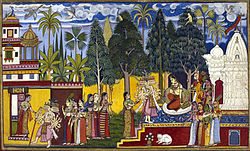
 Rama with his wife Sita and brother Lakshmana during exile in forest, manuscript, ca. 1780 | |
| Information | |
| Faith | Sanatana Dharma |
| Writer | Valmiki |
| Language | Sanskrit |
| Chapters | 500 Sargas 7 Kandas |
| Verses | 24,000 |
| | |

Rāmāyana (;[ane] [two] Sanskrit: रामायणम्,[iii] IAST: Rāmāyaṇam pronounced [raːˈmaːjɐɳɐm]) is one of the two major Sanskrit epics of aboriginal India and important text of Hinduism, the other being the Mahābhārata.[iv]
The epic, traditionally ascribed to the Maharishi Valmiki, narrates the life of Rama, a legendary prince of Ayodhya city in the kingdom of Kosala. The epic follows his fourteen-year exile to the forest urged by his father King Dasharatha, on the asking of Rama's stepmother Kaikeyi; his travels across forests in the Indian subcontinent with his wife Sita and brother Lakshmana, the kidnapping of Sita by Ravana – the male monarch of Lanka, that resulted in war; and Rama'south eventual render to Ayodhya to be crowned male monarch amidst jubilation and celebration.
The Ramayana is one of the largest ancient epics in world literature. It consists of about 24,000 verses (by and large set in the Shloka/Anustubh meter), divided into seven kāṇḍa south, the offset and the seventh being subsequently additions.[5] It belongs to the genre of Itihasa, narratives of past events ( purāvṛtta ), interspersed with teachings on the goals of human life. Scholars' estimates for the primeval stage of the text range from the 7th to quaternary centuries BCE,[half dozen] [7] with later stages extending up to the 3rd century CE.[8]
At that place are many versions of Ramayana in Indian languages, besides Buddhist, Sikh and Jain adaptations. In that location are also Cambodian (Reamker), Indonesian, Filipino, Thai (Ramakien), Lao, Burmese and Malay versions of the tale. Retellings include Kamban'due south Ramavataram in Tamil (c. 11th–12th century), Champu Ramayanam[9] of Bhoja (c. 11th century), Gona Budda Reddy'south Ranganatha Ramayanam in Telugu (c. 13th century), Madhava Kandali's Saptakanda Ramayana in Assamese (c. 14th century), Krittibas Ojha's Krittivasi Ramayan (also known equally Shri Ram Panchali) in Bengali (c. 15th century), Sarala Das' Vilanka Ramayana (c. 15th century)[10] [eleven] [12] [13] and Balarama Dasa's Jagamohana Ramayana (also known as the Dandi Ramayana) (c. 16th century) both in Odia, sant Eknath's Bhavarth Ramayan (c. 16th century) in Marathi, Tulsidas' Ramcharitamanas (c. 16th century) in Awadhi (which is an eastern course of Hindi) and Thunchaththu Ezhuthachan'southward Adhyathmaramayanam in Malayalam (c. 17th century).
The Ramayana was an important influence on subsequently Sanskrit poetry and Hindu life and civilisation. The characters Rama, Sita, Lakshmana, Bharata, Hanuman, and Ravana are all fundamental to the cultural consciousness of the South Asian nations of India, Bangladesh, Nepal, Sri Lanka and the South-East Asian countries of Cambodia, Indonesia, Malaysia and Thailand. Its nigh of import moral influence was the importance of virtue, in the life of a citizen and in the ideals of the germination of a land or of a functioning guild.
Etymology [edit]
The name Rāmāyaṇa is composed of two words, Rāma and ayaṇa . Rāma , the proper name of the primal figure of the epic, has two contextual meanings. In the Atharvaveda, it means 'dark, dark-coloured, black' and is related to the give-and-take rātri which means 'darkness or stillness of nighttime'. The other meaning, which can be plant in the Mahabharata, is 'pleasing, pleasant, charming, lovely, cute'.[xiv] [fifteen] The word ayana means travel or journeying. Thus, Rāmāyaṇa means "Rama's progress", with ayana altered to ayaṇa due to the Sanskrit grammar dominion of internal sandhi.[16] [17]
Textual characteristics [edit]

An artist's impression of sage Valmiki composing the Ramayana
Genre [edit]
The Ramayana belongs to the genre of Itihasa, narratives of by events ( purāvṛtta ), which includes the Mahabharata, the Puranas, and the Ramayana. The genre also includes teachings on the goals of homo life. It depicts the duties of relationships, portraying ideal characters like the platonic father, the ideal servant, the ideal brother, the ideal married man, and the ideal male monarch. Like the Mahabharata, Ramayana presents the teachings of ancient Hindu sages in the narrative apologue, interspersing philosophical and ethical elements.[ commendation needed ]
Structure [edit]
In its extant form, Valmiki's Ramayana is an ballsy verse form of some 24,000 verses, divided into 7 kāṇḍa due south (Bālakāṇḍa, Ayodhyakāṇḍa, Araṇyakāṇḍa, Kiṣkindakāṇḍa, Sundarākāṇḍa, Yuddhakāṇḍa), and nigh 500 sargas (chapters).[5] [18]
Dating [edit]

Astronomically, the narrative of the Ramayana took place during a period of time known every bit Treta Yuga in 5301 BC .[19]
According to Robert P. Goldman, the oldest parts of the Ramayana date to between the mid-7th century BCE and the mid-6th century BCE. This is due to the narrative not mentioning Buddhism nor the prominence of Magadha. The text also mentions Ayodhya as the capital of Kosala, rather than its later on name of Saketa or the successor majuscule of Shravasti.[6] In terms of narrative time, the action of the Ramayana predates the Mahabharata. Scholarly estimates for the primeval stage of the available text range from the 7th to quaternary centuries BCE,[6] [7] [ unreliable source? ] with later stages extending up to the 3rd century CE.[8]
Books 2 to six are the oldest portion of the ballsy, while the get-go and concluding books (Bala Kanda and Uttara Kanda, respectively) seem to be after additions. Style differences and narrative contradictions betwixt these two volumes and the rest of the epic have led scholars since Hermann Jacobi to the present toward this consensus.[xx]
Recensions [edit]
The Ramayana text has several regional renderings, recensions, and sub-recensions. Textual scholar Robert P. Goldman differentiates 2 major regional revisions: the northern (n) and the southern (s). Scholar Romesh Chunder Dutt writes that "the Ramayana, like the Mahabharata, is a growth of centuries, but the main story is more than distinctly the creation of one mind."
A Times of India report dated xviii December 2015 informs about the discovery of a 6th-century manuscript of the Ramayana at the Asiatic Social club library, Kolkata.[21]
There has been word every bit to whether the kickoff and the last volumes (Bala Kanda and Uttara Kanda) of Valmiki'southward Ramayana were composed by the original author. The uttarākāṇḍa, the bālakāṇḍa, although oftentimes counted among the main ones, is not a part of the original epic. Though Balakanda is sometimes considered in the primary epic, co-ordinate to many Uttarakanda is certainly a later interpolation and thus is non attributed to the work of Maharshi Valmiki.[v] This fact is reaffirmed by the absence of these two Kāndas in the oldest manuscript.[21] Many Hindus don't believe they are integral parts of the scripture because of some style differences and narrative contradictions betwixt these two volumes and the rest.[22]
Characters [edit]
Synopsis [edit]
Bala Kanda [edit]

The marriage of the 4 sons of Dasharatha with the four daughters of Siradhvaja Janaka and Kushadhvaja. Rama and Sita, Lakshmana and Urmila, Bharata and Mandavi and Shatrughna with Shrutakirti.
This Sarga (section) details the stories of Rama's childhood and events related to the time frame. Dasharatha was the King of Ayodhya. He had three wives: Kaushalya, Kaikeyi, and Sumitra. He did not accept a son and in the want to accept a legal heir performs a burn cede known as Putra-kameshti Yajna. As a consequence, Rama was starting time born to Kaushalya, Bharata was born to Kaikeyi, Lakshmana and Shatrughna were born to Sumitra.
These sons are endowed, to diverse degrees, with the essence of the Supreme Trinity Entity Vishnu; Vishnu had opted to be born into bloodshed to gainsay the demon Ravana, who was oppressing the gods, and who could just exist destroyed by a mortal. The boys were reared as the princes of the realm, receiving instructions from the scriptures and in warfare from Vashistha. When Rama was 16 years old, sage Vishwamitra comes to the courtroom of Dasharatha in search of help confronting demons who were agonizing sacrificial rites. He chooses Rama, who is followed by Lakshmana, his constant companion throughout the story. Rama and Lakshmana receive instructions and supernatural weapons from Vishwamitra and go along to destroy Tataka and many other demons.
Janaka was the King of Mithila. One day, a female person child was found in the field by the King in the deep furrow dug past his plough. Overwhelmed with joy, the Male monarch regarded the child equally a "miraculous gift of God". The child was named Sita, the Sanskrit discussion for furrow. Sita grew upwards to be a girl of unparalleled beauty and amuse. The King had decided that whoever could lift and wield a heavy bow, presented to his ancestors by Shiva, could marry Sita.[23]
Sage Vishwamitra takes Rama and Lakshmana to Mithila to bear witness the bow. And so Rama desires to lift it and goes on to wield the bow and when he draws the cord, it bankrupt.[23] Marriages were arranged betwixt the sons of Dasharatha and daughters of Janaka. Rama marries Sita, Lakshmana to Urmila, Bharata to Mandavi and Shatrughna to Shrutakirti. The weddings were celebrated with swell festivity in Mithila and the union party returns to Ayodhya.
Ayodhya Kanda [edit]

After Rama and Sita take been married, an elderly Dasharatha expresses his desire to crown Rama, to which the Kosala associates and his subjects express their support. On the eve of the great event, Kaikeyi was happy about this. Was later provoked by Manthara, a wicked maidservant – claims two boons that Dasharatha had long ago granted her. Kaikeyi demands Rama to exist exiled into the wilderness for fourteen years, while the succession passes to her son Bharata.
The heartbroken king, constrained by his rigid devotion to his given give-and-take, accedes to Kaikeyi'due south demands. Rama accepts his father's reluctant decree with absolute submission and calm self-control which characterizes him throughout the story. He is joined past Sita and Lakshmana. When he asks Sita not to follow him, she says, "the forest where y'all dwell is Ayodhya for me, and Ayodhya without you is a veritable hell for me."
Later Rama's departure, King Dasharatha, unable to bear the grief, passes away. Meanwhile, Bharata, who was on a visit to his maternal uncle, learns about the events in Ayodhya. Bharata refuses to profit from his female parent'south wicked scheming and visits Rama in the forest. He requests Rama to return and rule. But Rama, determined to carry out his father's orders to the letter, refuses to render before the period of exile.

Rama leaving for fourteen years of exile from Ayodhya.
Aranya Kanda [edit]

After 13 years of exile, Rama, Sita, and Lakshmana journeying due south along the banks of the river Godavari, where they build cottages and alive off the land. At the Panchavati forest they are visited by a rakshasi named Shurpanakha, sis of Ravana. She tries to seduce the brothers and, later failing, attempts to kill Sita. Lakshmana stops her past cutting off her nose and ears. Hearing of this, her brothers Khara and Dushan organize an attack confronting the princes. Rama defeats Khara and his rakshasas.
When the news of these events reaches Ravana, he resolves to destroy Rama by capturing Sita with the aid of the rakshasa Maricha. Maricha, assuming the form of a golden deer, captivates Sita'due south attention. Entranced by the beauty of the deer, Sita pleads with Rama to capture it. Rama, aware that this is the ploy of the demons, cannot dissuade Sita from her desire and chases the deer into the forest, leaving Sita under Lakshmana's baby-sit.
After some time, Sita hears Rama calling out to her; agape for his life, she insists that Lakshmana blitz to his aid. Lakshmana tries to clinch her that Rama cannot exist hurt that hands and that it is best if he continues to follow Rama's orders to protect her. On the verge of hysterics, Sita insists that it is not she but Rama who needs Lakshman'south help. He obeys her wish but stipulates that she is not to get out the cottage or entertain any stranger. With the coast finally clear, Ravana appears in the guise of an austere requesting Sita'south hospitality. Unaware of her guest's programme, Sita is tricked and is then forcibly carried abroad by Ravana.[24]
Jatayu, a vulture, tries to rescue Sita but is mortally wounded. In Lanka, Sita is kept under the guard of rakshasis. Ravana asks Sita to ally him, but she refuses, being totally devoted to Rama. Meanwhile, Rama and Lakshmana learn about Sita's abduction from Jatayu and immediately gear up out to salvage her. During their search, they meet Kabandha and the ascetic Shabari, who direct them towards Sugriva and Hanuman.
Kishkindha Kanda [edit]

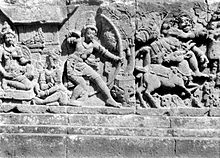
A stone bas-relief at Banteay Srei in Cambodia depicts the combat between Vali and Sugriva (center). To the right, Rama fires his bow. To the left, Vali lies dying.
Kishkindha Kanda is prepare in the ape (Vanara) citadel Kishkindha. Rama and Lakshmana meet Hanuman, the biggest devotee of Rama, greatest of ape heroes, and an adherent of Sugriva, the banished pretender to the throne of Kishkindha. Rama befriends Sugriva and helps him past killing his elder brother Vali thus regaining the kingdom of Kishkindha, in exchange for helping Rama to recover Sita.
All the same, Sugriva soon forgets his promise and spends his fourth dimension enjoying his newly gained power. The clever former ape queen Tara (wife of Vali) calmly intervenes to prevent an enraged Lakshmana from destroying the ape citadel. She then eloquently convinces Sugriva to honor his pledge. Sugriva then sends search parties to the four corners of the globe, but to return without success from n, due east, and westward. The southern search party under the leadership of Angada and Hanuman learns from a vulture named Sampati (elder brother of Jatayu), that Sita was taken to Lanka.
Sundara Kanda [edit]
Ravana is meeting Sita at Ashokavana. Hanuman is seen on the tree.
Sundara Kanda forms the centre of Valmiki's Ramayana and consists of a detailed, brilliant account of Hanuman'due south heroics. Later learning near Sita, Hanuman assumes a gargantuan class and makes a colossal spring across the sea to Lanka. On the mode, he meets with many challenges like facing a Gandharva Kanya who comes in the grade of a demon to test his abilities. He encounters a mountain named Mainakudu who offers Hanuman aid and offers him rest. Hanuman refuses because there is little time remaining to consummate the search for Sita.
After entering Lanka, he finds a demon, Lankini, who protects all of Lanka. Hanuman fights with her and subjugates her in social club to become into Lanka. In the process, Lankini, who had an earlier vision/warning from the gods, therefore, knows that the end of Lanka nears if someone defeats Lankini. Here, Hanuman explores the demons' kingdom and spies on Ravana. He locates Sita in Ashoka grove, where she is beingness wooed and threatened by Ravana and his rakshasis to marry Ravana.
Hanuman reassures Sita, giving Rama'due south signet band as a sign that Rama is still live. He offers to carry Sita back to Rama; however, she refuses and says that it is not the dharma, stating that Ramayana will not have significance if Hanuman carries her to Rama – "When Rama is not there Ravana carried Sita forcibly and when Ravana was not in that location, Hanuman carried Sita back to Rama". She says that Rama himself must come and avenge the insult of her abduction. She gives Hanuman her comb equally a token to prove that she is still alive.
Hanuman asks Sita for food to eat equally he was hungry. Sita tells him that she is only immune to swallow the fruits that are fallen from the copse and he may besides discover some on the ground to eat. Aroused Hanumam then wreaks havoc in Lanka past destroying trees in the Naulakha Bagh and buildings and killing Ravana's warriors. He allows himself to exist captured and delivered to Ravana. He gives a bold lecture to Ravana to release Sita. He is condemned and his tail is gear up on fire, just he escapes his bonds and leaps from roof to roof, sets burn down to Ravana's citadel, and makes the giant leap dorsum from the island. The joyous search political party returns to Kishkindha with the news.
Yuddha Kanda [edit]

The Battle at Lanka, Ramayana by Sahibdin. Information technology depicts the monkey army of the protagonist Rama (meridian left, blue effigy) fighting Ravana—the demon-king of the Lanka—to relieve Rama's kidnapped wife, Sita. The painting depicts multiple events in the boxing against the three-headed demon general Trishira, in the lesser left. Trishira is beheaded by Hanuman, the monkey-companion of Rama.
Also known equally Lanka Kanda, this book describes the state of war between the army of Rama and the ground forces of Ravana. Having received Hanuman'due south report on Sita, Rama and Lakshmana go on with their allies towards the shore of the southern sea. There they are joined past Ravana's renegade brother Vibhishana. The apes named Nala and Nila construct a floating bridge (known as Rama Setu)[25] across the sea, using stones that floated on water because they had Rama'southward name written on them and one story besides tells that they had been cursed by a sage that whatever they will throw in a h2o body will non sink rather information technology will float.
The princes and their army cross over to Lanka. A lengthy state of war ensues. During a boxing, Ravana's son Indrajit hurls a powerful weapon at Lakshmana, who is badly wounded. And so Hanuman assumes a gigantic grade and flies from Lanka to the Himalayas. Upon reaching Mount Sumeru, Hanuman was unable to place the herb that could cure Lakshmana and and then decided to bring the entire mountain back to Lanka. Eventually, the war ends when Rama kills Ravana. Rama then installs Vibhishana on the throne of Lanka.
On meeting Sita, Ram said, "the dishonour meted out to him and the wrong done to her by Ravana have been wiped off, by his victory over the enemy with the assist of Hanuman, Sugreeva and Vibhishana".[26] However, embarrassed by the implication that Sita was unfaithful, Rama disowns her and asks her to seek shelter elsewhere. Sita requests Lakshmana to set a pile of fire for her to enter. When Lakshmana prepares a pyre, Sita prays god Agni and enters into it, in order to prove her conjugal fidelity. God Agni appears in person from the burning pyre, carrying Sita in his artillery and restores her to Rama, testifying to her purity.[27] Rama later joyfully accepts her. The episode of Agni Pariksha varies in the versions of Ramayana by Valmiki and Tulsidas. In Tulsidas's Ramacharitamanas, Sita was under the protection of Agni (run into Maya Sita) so information technology was necessary to bring her out earlier reuniting with Rama.
Uttara Kanda [edit]

Information technology narrates Rama'due south reign of Ayodhya, the birth of Lava and Kusha, the Ashvamedha yajna and last days of Rama. At the expiration of his term of exile, Rama returns to Ayodhya with Sita, Lakshmana, and Hanuman, where the coronation is performed. On being asked to testify his devotion to Rama, Hanuman tears his chest open and to everyone's surprise, in that location is an image of Rama and Sita within his chest. Rama rules Ayodhya and the reign is called Ram-Rajya (a place where the common folk is happy, fulfilled, and satisfied).
This volume (kanda) is not considered to be a part of the original epic but instead a afterward add-on to the earliest layers of the Valmiki Ramayana and is considered to be highly interpolated. In this kanda, Rama is crowned ruler. The legend goes that i day Rama overhears the conversation of a fisherman and his married woman. The married woman allegedly spent a night in his absence and the fisherman is furious at his married woman. He calls Rama shameless as he rescued Sita, who had spent a long time at Lanka in the presence of another man.
Rama was furious as Sita had proved to everyone she was pure, through Agnipravesh. Sita, who was pregnant was sent to exile into the forest. She finds refuge in Sage Valmiki'due south ashram, where she gives nativity to twin boys, Lava and Kusha. Meanwhile, Rama conducts an Ashwamedha yajna (A holy announcement of the authority of the king) and in absenteeism of Sita places a golden statue of Sita.
Lava and Kusha capture the horse (sign of the yajna) and defeat the whole army of Ayodhya which come to protect the horse. Later on on, both the brothers defeat Lakshmana, Bharata, Shatrughan and other warriors and take Hanuman equally prisoner. Finally Rama himself arrives and defeats the two mighty brothers. Valmiki updates Sita about this development and advises both the brothers to go to Ayodhya and tell the story of Sita's sacrifice to the common folk. Both brothers arrive at Ayodhya just face many difficulties while convincing the people. Hanuman helps both the brothers in this task.
At 1 bespeak, Valmiki brings Sita forward. Seeing Sita, Rama is teary eyed and realises that Lava and Kusha are his ain sons. Once more complicit Nagarsen (1 of the primaries who instigated the hatred towards Sita) challenges Sita's character and asks her to prove her purity. Sita is overflown with emotions and decides to go dorsum to Mother Globe from where she emerged. She says that, "If I am pure, this earth volition open up and swallow me whole."
At that very moment, the earth opens up and swallows Sita. Rama rules Ayodhya for many years and finally takes Samadhi into Sarayu river forth with his three brothers and leaves the world. He goes back to Vaikuntha in his Vishnu form (Lakshmana every bit Shesh Naga, Bharata as his conch and Shatrughana every bit the Sudarshan Chakra) and meets Sita there who by so assumed the form of Lakshmi.
Versions [edit]

The epic story of Ramyana was adopted by several cultures beyond Asia. Shown here is a Thai historic artwork depicting the battle which took identify between Rama and Ravana.
Every bit in many oral epics, multiple versions of the Ramayana survive. In particular, the Ramayana related in north India differs in important respects from that preserved in south India and the residual of southeast Asia. In that location is an extensive tradition of oral storytelling based on Ramayana in Indonesia, Cambodia, Philippines, Thailand, Malaysia, Laos, Vietnam and Maldives.
India [edit]
There are diverse regional versions of the Ramayana written by various authors in Republic of india. Some of them differ significantly from each other. A West Bengal manuscript from the 6th century presents the epic without ii of its kandas. During the 12th century, Kamban wrote Ramavataram, known popularly as Kambaramayanam in Tamil, but references to Ramayana story announced in Tamil literature every bit early as third century CE. A Telugu version, Ranganatha Ramayanam, was written by Gona Budda Reddy in the 14th century.
The earliest translation to a regional Indo-Aryan linguistic communication is the early 14th century Saptakanda Ramayana in Assamese by Madhava Kandali. Valmiki'south Ramayana inspired Sri Ramacharit Manas by Tulsidas in 1576, an epic Awadhi (a dialect of Hindi) version with a camber more than grounded in a unlike realm of Hindu literature, that of bhakti; it is an acknowledged masterpiece of India, popularly known as Tulsi-krita Ramayana. Gujarati poet Premanand wrote a version of the Ramayana in the 17th century.
Other versions include Krittivasi Ramayan, a Bengali version by Krittibas Ojha in the 15th century; Vilanka Ramayana by 15th century poet Sarala Dasa[28] and Jagamohana Ramayana (as well known as Dandi Ramayana) by 16th century poet Balarama Dasa, both in Odia; a Torave Ramayana in Kannada by 16th-century poet Narahari; Adhyathmaramayanam, a Malayalam version by Thunchaththu Ramanujan Ezhuthachan in the 16th century; in Marāthi by Sridhara in the 18th century; in Maithili by Chanda Jha in the 19th century; and in the 20th century, Rashtrakavi Kuvempu's Sri Ramayana Darshanam in Kannada and Srimad Ramayana Kalpavrikshamu in Telugu by Viswanatha Satyanarayana who received Jnanapeeth award for this work.
In that location is a sub-plot to the Ramayana, prevalent in some parts of India, relating the adventures of Ahiravan and Mahi Ravana, evil brother of Ravana, which enhances the role of Hanuman in the story. Hanuman rescues Rama and Lakshmana after they are kidnapped past the Ahi-Mahi Ravana at the behest of Ravana and held prisoner in a cave, to be sacrificed to the goddess Kali. Adbhuta Ramayana is a version that is obscure but too attributed to Valmiki – intended as a supplementary to the original Valmiki Ramayana. In this variant of the narrative, Sita is accorded far more prominence, such as elaboration of the events surrounding her nascence – in this example to Ravana's wife, Mandodari also as her conquest of Ravana'southward older brother in the Mahakali grade.
The Gondi people have their ain version of the Ramayana known as the Gond Ramayani, derived from oral folk legends. Information technology consists of seven stories with Lakshmana as the protagonist, ready after the chief events of the Ramayana, where he finds a helpmate.[29]
Early medieval recension from Bengal [edit]
Chance discovery of a 6th-century manuscript reveals insights into the development of the narrative. Chiefly, the 'Daśagrīvā Rākṣasa Charitrām Vadham' (Slaying of the Ten-Headed Behemothic) manuscript contains only five kandas (capacity), and ends with the trio'south triumphant render to Ayodhya.[30] [31]
Missing from this detail recension are the 'Balakanda' dealing with Rama's childhood, and the 'Uttarakanda' – which narrates (a) Rama'south divinity as an avatar of Vishnu, (b) the events leading up to the exile of Sita, (c) the death of Rama'due south devoted blood brother, Lakshmana. These are also the only two books where the Sage Valmiki appears as a character.[32]
The manuscript was discovered in 2015, from an archive compiled by the German Indologist Theodor Aufrecht.
Early references in Tamil literature [edit]
Even before Kambar wrote the Ramavataram in Tamil in the 12th century Advert, there are many ancient references to the story of Ramayana, implying that the story was familiar in the Tamil lands even earlier the Common Era. References to the story can be plant in the Sangam literature of Akanaṉūṟu,(dated 1st century BCE)[33] and Purananuru (dated 300 BC),[34] [35] the twin epics of Silappatikaram (dated 2nd Century CE)[36] and Manimekalai (cantos five, 17 and eighteen),[37] [38] [39] and the Alvar literature of Kulasekhara Alvar, Thirumangai Alvar, Andal and Nammalvar (dated between fifth and 10th Centuries CE).[40] Even the songs of the Nayanmars have references to Ravana and his devotion to Lord Siva.
Buddhist version [edit]
In the Buddhist variant of the Ramayana (Dasaratha Jataka), Dasharatha was rex of Benares and not Ayodhya. Rama (chosen Rāmapaṇḍita in this version) was the son of Kaushalya, get-go wife of Dasharatha. Lakṣmaṇa (Lakkhaṇa) was a sibling of Rama and son of Sumitra, the second wife of Dasharatha. Sita was the wife of Rama. To protect his children from his married woman Kaikeyi, who wished to promote her son Bharata, Dasharatha sent the three to a hermitage in the Himalayas for a twelve-year exile.
After nine years, Dasharatha died and Lakkhaṇa and Sita returned. Rāmapaṇḍita, in deference to his father's wishes, remained in exile for a further two years. This version does not include the abduction of Sītā.There is no Ravan in this version i.due east. no Ram-ravan state of war.
In the explanatory commentary on Jātaka, Rāmapaṇḍita is said to have been a previous birth of the Buddha, and Sita as previous nascence of Yasodharā(Rahula-Mata).
Simply, Ravana appears in other Buddhist literature, the Lankavatara Sutra.
Jain versions [edit]
Jain versions of the Ramayana tin be plant in the various Jain agamas like Saṅghadāsagaṇī Vāchaka's Vasudevahiṇḍī (circa 4th century CE),[41] Ravisena'due south Padmapurana (story of Padmaja and Rama, Padmaja being the proper noun of Sita), Hemacandra'due south Trisastisalakapurusa charitra (hagiography of 63 illustrious persons), Sanghadasa'south Vasudevahindi and Uttarapurana by Gunabhadara. According to Jain cosmology, every half fourth dimension cycle has 9 sets of Balarama, Vasudeva and prativasudeva.
Rama, Lakshmana and Ravana are the eighth Baldeva, Vasudeva and prativasudeva respectively. Padmanabh Jaini notes that, unlike in the Hindu Puranas, the names Baladeva and Vasudeva are not restricted to Balarama and Krishna in Jain Puranas. Instead they serve every bit names of two distinct classes of mighty brothers, who appear nine times in each half fourth dimension cycle and jointly rule one-half the earth equally half-chakravartins. Jaini traces the origin of this listing of brothers to the jinacharitra (lives of jinas) by Acharya Bhadrabahu (3d–fourth century BCE).
In the Jain epic of Ramayana, it is not Rama who kills Ravana as told in the Hindu version. Perhaps this is because Rama, a liberated Jain Self in his terminal life, is unwilling to kill.[42] Instead, it is Lakshmana who kills Ravana (as Vasudeva killes Prativasudeva).[42] In the end, Rama, who led an upright life, renounces his kingdom, becomes a Jain monk and attains moksha. On the other hand, Lakshmana and Ravana go to Hell. Notwithstanding, it is predicted that ultimately they both will be reborn equally upright persons and attain liberation in their future births. According to Jain texts, Ravana volition exist the futurity Tirthankara (omniscient teacher) of Jainism.
The Jain versions have some variations from Valmiki'due south Ramayana. Dasharatha, the king of Ayodhya had iv queens: Aparajita, Sumitra, Suprabha and Kaikeyi. These four queens had four sons. Aparajita'southward son was Padma and he became known by the name of Rama. Sumitra's son was Narayana: he came to be known by another name, Lakshmana. Kaikeyi's son was Bharata and Suprabha'southward son was Shatrughna. Furthermore, not much was thought of Rama'due south allegiance to Sita. Co-ordinate to the Jain version, Rama had four chief queens: Maithili, Prabhavati, Ratinibha, and Sridama.
Furthermore, Sita takes renunciation every bit a Jain austere afterward Rama abandons her and is reborn in sky as Indra. Rama, afterward Lakshman'southward decease, also renounces his kingdom and becomes a Jain monk. Ultimately, he attains Kevala Jnana omniscience and finally liberation. Rama predicts that Ravana and Lakshmana, who were in the fourth hell, volition achieve liberation in their future births. Accordingly, Ravana is the future Tirthankara of the next half ascending fourth dimension cycle and Sita will be his Ganadhara.
Sikh version [edit]
In the holiest Sikh scripture the Guru Granth Sahib, at that place is a description of two types of Ramayana. 1 is a spiritual Ramayana which is the actual subject field of Guru Granth Sahib, in which Ravana is ego, Sita is budhi (intellect), Rama is inner Self and Laxman is isle of man (attention, mind). Guru Granth Sahib likewise believes in the being of Dashavatara who were kings of their times which tried their best to restore social club to the world. Male monarch Rama (Ramchandra) was one of those who is non covered in Guru Granth Sahib. Guru Granth Sahib states:
- ਹੁਕਮਿ ਉਪਾਏ ਦਸ ਅਉਤਾਰਾ॥
- हुकमि उपाए दस अउतारा॥
- Past hukam (supreme control), he created his ten incarnations
Rather there is no Ramayana written past any Guru. Guru Gobind Singh yet is known to have written Ram Avatar in a text which is highly debated on its authenticity. Guru Gobind Singh clearly states that though all the 24 avatars incarnated for the edification of the world, but fell prey to ego and therefore were destroyed by the supreme creator.[ citation needed ].
He also said that the almighty, invisible, all prevailing God created groovy numbers of Indras, Moons and Suns, Deities, Demons and sages, and likewise numerous saints and Brahmanas (aware people). But they too were caught in the noose of death (Kaal) (transmigration of the soul).[ citation needed ]
Nepal [edit]
As well being the site of discovery of the oldest surviving manuscript of the Ramayana, Nepal gave ascent to two regional variants in mid 19th – early 20th century. 1, written by Bhanubhakta Acharya, is considered the first ballsy of Nepali language, while the other, written by Siddhidas Mahaju in Nepal Bhasa was a foundational influence in the Nepal Bhasa renaissance.
Ramayana written past Bhanubhakta Acharya is one of the most popular verses in Nepal. The popularization of the Ramayana and its tale, originally written in Sanskrit Language was greatly enhanced by the work of Bhanubhakta. Mainly considering of his writing of Nepali Ramayana, Bhanubhakta is also called Aadi Kavi or The Pioneering Poet.
Southeast Asian [edit]
Kingdom of cambodia [edit]

Cambodian classical dancers as Sita and Ravana, the Majestic Palace in Phnom Penh (c. 1920s)
The Cambodian version of the Ramayana, Reamker (Khmer: រាមកេរ្ដិ៍ - Glory of Rama), is the near famous story of Khmer literature since the Kingdom of Funan era. It adapts the Hindu concepts to Buddhist themes and shows the balance of good and evil in the globe. The Reamker has several differences from the original Ramayana, including scenes not included in the original and emphasis on Hanuman and Sovann Maccha, a retelling which influences the Thai and Lao versions. Reamker in Cambodia is non bars to the realm of literature but extends to all Cambodian art forms, such as sculpture, Khmer classical dance, theatre known as lakhorn luang (the foundation of the royal ballet), verse and the landscape and bas-reliefs seen at the Silverish Pagoda and Angkor Wat.
Indonesia [edit]
In that location are several Indonesian adaptations of Ramayana, including the Javanese Kakawin Ramayana [43] [44] and Balinese Ramakavaca. The first half of Kakawin Ramayana is like to the original Sanskrit version, while the latter half is very different. I of the recognizable modifications is the inclusion of the indigenous Javanese guardian demigod, Semar, and his sons, Gareng, Petruk, and Bagong who make up the numerically significant four Punokawan or "clown servants".[45]
Kakawin Ramayana is believed to have been written in Central Java circa 870 Advertizing during the reign of Mpu Sindok in the Medang Kingdom.[45] The Javanese Kakawin Ramayana is non based on Valmiki's epic, which was then the most famous version of Rama'due south story, but based on Ravanavadha or the "Ravana massacre", which is the sixth or 7th century poem by Indian poet Bhattikavya.[46]
Kakawin Ramayana was further developed on the neighboring island of Bali becoming the Balinese Ramakavaca. The bas-reliefs of Ramayana and Krishnayana scenes are carved on balustrades of the ninth century Prambanan temple in Yogyakarta,[47] also as in the 14th century Penataran temple in East Java.[48] In Indonesia, the Ramayana is a securely ingrained attribute of the culture, specially among Javanese, Balinese and Sundanese people, and has become the source of moral and spiritual guidance as well as artful expression and entertainment, for example in wayang and traditional dances.[49]
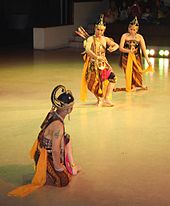
The Balinese kecak dance for example, retells the story of the Ramayana, with dancers playing the roles of Rama, Sita, Lakhsmana, Jatayu, Hanuman, Ravana, Kumbhakarna and Indrajit surrounded by a troupe of over 50 bare-chested men who serve as the chorus chanting "cak". The performance besides includes a fire show to describe the burning of Lanka by Hanuman.[fifty] In Yogyakarta, the Wayang Wong Javanese dance also retells the Ramayana. Ane example of a dance production of the Ramayana in Coffee is the Ramayana Ballet performed on the Trimurti Prambanan open air stage, with dozens of actors and the three main prasad spires of the Prambanan Hindu temple as a properties.[51]
Lao people's democratic republic [edit]
Phra Lak Phra Lam is a Lao language version, whose championship comes from Lakshmana and Rama. The story of Lakshmana and Rama is told as the previous life of Gautama buddha.
Malaysia [edit]
The Hikayat Seri Rama of Malaysia incorporated element of both Hindu and Islamic mythology.[52] [53] [54]
Myanmar [edit]
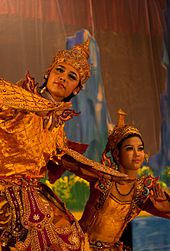
Rama (Yama) and Sita (Me Thida) in Yama Zatdaw, the Burmese version of Ramyana
Yama Zatdaw is the Burmese version of Ramayana. Information technology is also considered the unofficial national epic of Myanmar. At that place are ix known pieces of the Yama Zatdaw in Myanmar. The Burmese name for the story itself is Yamayana, while zatdaw refers to the acted play or being office of the jataka tales of Theravada Buddhism. This Burmese version is too heavily influenced by Ramakien (Thai version of Ramayana) which resulted from various invasions by Konbaung Dynasty kings toward the Ayutthaya Kingdom.
Philippines [edit]
The Maharadia Lawana, an ballsy poem of the Maranao people of the Philippines, has been regarded every bit an indigenized version of the Ramayana since information technology was documented and translated into English by Professor Juan R. Francisco and Nagasura Madale in 1968.[55] : "264" [56] The verse form, which had non been written downwards before Francisco and Madale'south translation,[55] : "264" narrates the adventures of the monkey-rex, Maharadia Lawana, to whom the Gods have granted immortality.[55]
Francisco, an indologist from the University of the Philippines Manila, believed that the Ramayana narrative arrived in the Philippines some time between the 17th to 19th centuries, via interactions with Javanese and Malaysian cultures which traded extensively with India.[57] : 101
By the time it was documented in the 1960s, the character names, identify names, and the precise episodes and events in Maharadia Lawana's narrative already had some notable differences from those of the Ramayana. Francisco believed that this was a sign of "indigenization", and suggested that some changes had already been introduced in Malaysia and Java even earlier the story was heard past the Maranao, and that upon reaching the Maranao homeland, the story was "further indigenized to suit Philippine cultural perspectives and orientations."[57] : "103"
Thailand [edit]

Thailand'southward popular national epic Ramakien (Thai: รามเกียรติ์, from rāmakīrti , 'glory of Ram') is derived from the Hindu epic. In Ramakien , Sita is the girl of Ravana and Mandodari ( thotsakan and montho ). Vibhishana ( phiphek ), the astrologer brother of Ravana, predicts the death of Ravana from Sita'due south horoscope. Ravana throws her into the h2o, but she is later rescued by Janaka ( chanok ).[42] : 149
While the principal story is identical to that of Ramayana, many other aspects were transposed into a Thai context, such as the clothes, weapons, topography and elements of nature, which are described equally beingness Thai in style. It has an expanded function for Hanuman and he is portrayed as a lascivious character. Ramakien tin can be seen in an elaborate illustration at Wat Phra Kaew in Bangkok.
Critical edition [edit]
A critical edition of the text was compiled in Republic of india in the 1960s and 1970s, by the Oriental Constitute at Maharaja Sayajirao Academy of Baroda, India, utilizing dozens of manuscripts collected from across Bharat and the surrounding region.[58] An English language translation of the critical edition was completed in November 2016 by Sanskrit scholar Robert P. Goldman of the University of California, Berkeley.[59] Another English translation of Disquisitional Edition of Valmiki Ramayana (in 3 volumes) with all-encompassing footnotes was done by an Indian Scholar, economist and translator Bibek Debroy in October, 2017.[60]
Influence on culture and art [edit]

A Ramlila actor wears the traditional attire of Ravanan.
Ane of the most important literary works of ancient India, the Ramayana has had a profound impact on art and culture in the Indian subcontinent and southeast Asia with the lone exception of Vietnam. The story ushered in the tradition of the next thou years of massive-calibration works in the rich diction of regal courts and Hindu temples. It has also inspired much secondary literature in various languages, notably Kambaramayanam by Tamil poet Kambar of the 12th century, Telugu linguistic communication Molla Ramayanam by poet Molla and Ranganatha Ramayanam by poet Gona Budda Reddy, 14th century Kannada poet Narahari's Torave Ramayana and 15th century Bengali poet Krittibas Ojha'south Krittivasi Ramayan, as well as the 16th century Awadhi version, Ramacharitamanas, written by Tulsidas.
Ramayanic scenes have likewise been depicted through terracottas, stone sculptures, bronzes and paintings.[61] These include the stone panel at Nagarjunakonda in Andhra Pradesh depicting Bharata's coming together with Rama at Chitrakuta (tertiary century CE).[61]
The Ramayana became popular in Southeast Asia during eighth century and was represented in literature, temple compages, dance and theatre. Today, dramatic enactments of the story of the Ramayana, known equally Ramlila, take place all across Bharat and in many places across the globe within the Indian diaspora.
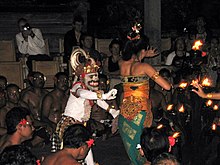
In Indonesia, especially Java and Bali, Ramayana has become a popular source of artistic expression for dance drama and shadow boob performances in the region. Sendratari Ramayana is the Javanese traditional ballet in wayang orang style, routinely performed in the cultural center of Yogyakarta. Big casts were role of outdoor and indoor performances presented regularly at Prambanan Trimurti temple for many years.[62] Balinese trip the light fantastic dramas of Ramayana were also performed frequently in Balinese Hindu temples in Ubud and Uluwatu, where scenes from Ramayana are an integral part of kecak trip the light fantastic toe performances. Javanese Wayang (Wayang Kulit of purwa and Wayang Wong) too depict from Ramayana or Mahabharata.
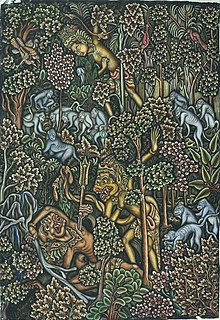
Ramayana has also been depicted in many paintings, notably by the Indonesian (Balinese) artists such as I Gusti Dohkar (before 1938), I Dewa Poetoe Soegih, I Dewa Gedé Raka Poedja, Ida Bagus Fabricated Togog before 1948 menstruum. Their paintings are currently in the National Museum of World Cultures collections of Tropenmuseum in Amsterdam, Netherland. Malaysian creative person Syed Thajudeen likewise depicted Ramayana in 1972. The painting is currently in the permanent collection of the Malaysian National Visual Arts Gallery.
In popular culture [edit]
Multiple modernistic, English-language adaptations of the ballsy exist, namely Rama Chandra Series past Amish Tripathi, Ramayana Series by Ashok Banker and a mythopoetic novel, Asura: Tale of the Vanquished past Anand Neelakantan. Another Indian writer, Devdutt Pattanaik, has published three different retellings and commentaries of Ramayana titled Sita, The Book Of Ram and Hanuman'due south Ramayan. A number of plays, movies and television serials have also been produced based upon the Ramayana.[63]
Stage [edit]

Hanoman At Kecak Fire Dance, Bali 2018
I of the best known Ramayana plays is Gopal Sharman'south The Ramayana, a contemporary interpretation in English, of the peachy ballsy based on the Valmiki Ramayana. The play has had more than than 3000 plus performances all over the earth, generally every bit a i-adult female performance by actress Jalabala Vaidya, wife of the playwright Gopal Sharman. The Ramayana has been performed on Broadway, London's West End, United Nations Headquarters, the Smithsonian Institution among other international venue and in more than 35 cities and towns in Republic of india.
Starting in 1978 and under the supervision of Baba Hari Dass, Ramayana has been performed every yr by Mount Madonna Schoolhouse in Watsonville, California.[ commendation needed ] It takes the class of a colorful musical with custom costumes, sung and spoken dialog, jazz-stone orchestration and trip the light fantastic. This performance takes identify in a large audience theater setting usually in June, in San Jose, CA. Dass has taught acting arts, costume-attire blueprint, mask making and choreography to bring alive characters of Rama, Sita, Hanuman, Lakshmana, Shiva, Parvati, Vibhishan, Jatayu, Sugriva, Surpanakha, Ravana and his rakshasa court, Meghnadha, Kumbhakarna and the army of monkeys and demons.[ citation needed ]
In the Philippines, a jazz ballet production was produced in the 1970s entitled "Rama at Sita" (Rama and Sita).
The production was a result of a collaboration of four National Artists, Bienvenido Lumbera's libretto (National Artist for Literature), product blueprint by Salvador Bernal (National Artist for Stage Design), music by Ryan Cayabyab (National Artist for Music) and choreography by Alice Reyes (National Artist for Dance).[64]
Plays [edit]
- Kanchana Sita, Saketham and Lankalakshmi – award-winning trilogy by Malayalam playwright C. North. Sreekantan Nair
- Lankeswaran – a play by the honor-winning Tamil cinema actor R. S. Manohar
- Kecak - a Balinese traditional folk trip the light fantastic which plays and tells the story of Ramayana
Exhibitions [edit]
- Gallery Nucleus:Ramayana Exhibition -Role of the art of the book Ramayana: Divine Loophole by Sanjay Patel.
- The Rama epic: Hero. Heroine, Ally, Foe past The Asian Art Museum.
Books [edit]
- Ramayana past C. Rajagopalachari
- The Ramayana by R. K. Narayan
- The Song of Rama by Vanamali
- Ramayana by William Cadet and S Triest
- Ramayana: Divine Loophole by Sanjay Patel
- Sita: An Illustrated Retelling of the Ramayana By Devdutt Pattanaik
- Hanuman'due south Ramayan By Devdutt Pattanaik
- Rama Chandra Serial by Amish Tripathi, a fictional retelling of the Ramayana. It has 3 books till now — Ram: Scion of Ikshvaku, Sita: Warrior of Mithila, and Raavan: Enemy of Aryavarta.
- Asura, Tale of the Vanquished by Anand Neelakantan, a novel.
- The Wood of Enchantments by Chitra Banerjee Divakaruni.
- The Crystal Guardian series by Ravi Venugopal, a mythological fiction trilogy, written from Rama'southward signal of view. Part ane - The Exiled Prince
Movies [edit]
- Lanka Dahan (1917)
- Ramayana (1942)
- Ram Rajya (1943)
- Rambaan (1948)
- Ramayan (1954)
- Sampoorna Ramayanam (1958)
- Sampoorna Ramayana (1961)
- Lava Kusha (1963)
- Sampoorna Ramayanamu (1971)
- Sita Kalyanam (1976)
- Kanchana Sita (1977)
- Ramayana: The Legend of Prince Rama (1992)
- Ramayanam (1996)
- Lav Kush (1997)
- Opera Jawa (2008)
- Sita Sings the Blues (2008)
- Ramayana: The Epic (2010)
- Lava Kusa: The Warrior Twins (2010)
- Raavanan (2010)
- Raavan (2010)
- Sri Rama Rajyam (2011)
- Yak: The Giant King (2012)
- Monkey Enters Lanka (2020)
- Adipurush (2022), upcoming film
TV series [edit]
- Ramayan – originally broadcast on Doordarshan, produced past Ramanand Sagar in 1987
- Luv Kush – originally broadcast on Doordarshan, produced by Ramanand Sagar in 1988
- Jai Hanuman – originally circulate on Doordarshan, produced and directed by Sanjay Khan
- Vishnu Puran (Boob tube series) - originally broadcast on Doordarshan, produced by B. R. Chopra in 2000
- Ramayan (2002) – originally broadcast on Zee Telly, produced by B.R. Chopra
- Ramayan (2008) – originally broadcast on Imagine TV, produced by Sagar Enterprise
- Ramayan (2012) – a remake of the 1987 series and aired on Zee TV
- Antariksh (2004) – a sci-fi version of Ramayan. Originally broadcast on Star Plus
- Raavan – series on life of Ravana based on Ramayana. Originally broadcast on Zee Television receiver
- Sankatmochan Mahabali Hanuman – 2015 series based on the life of Hanuman presently dissemination on Sony TV
- Siya Ke Ram – a serial on Star Plus, originally broadcast from 16 November 2015 to iv Nov 2016 series based on "Ramayan", showing Ramayan from Sita's prospective
- Ravana - a serial on Telly Derana from Sri Lanka, originally broadcast on 2019.
- Rama Siya Ke Luv Kush – 2019 series based on Uttar Ramayan, showing the life of children of Rama Sita, Kush and Luv broadcasting on Colors TV
References [edit]
- ^ "Ramayana". Random Business firm Webster's Unabridged Dictionary.
- ^ "Ramayana | Significant of Ramayana past Lexico". Lexico Dictionaries | English language . Retrieved 19 February 2020.
- ^ The Rámáyan of Válmíki.
- ^ "Ramayana | Summary, Characters, & Facts". Encyclopedia Britannica . Retrieved 18 February 2020.
- ^ a b c "Valmiki Ramayana". valmikiramayan.net . Retrieved 19 May 2020.
- ^ a b c Goldman 1984, p. 20–22.
- ^ a b Pattanaik, Devdutt (8 August 2020). "Was Ram born in Ayodhya". mumbaimirror.
- ^ a b J. L. Brockington (1998). The Sanskrit Epics. BRILL. pp. 379–. ISBN90-04-10260-4.
- ^ Malwa), Bhojarāja (Male monarch of (1924). Champu-Ramayana (in Sanskrit). Pandurang Jawali.
- ^ Mukherjee, P. (1981). The History of Medieval Vaishnavism in Orissa. Asian Educational Services. p. 74. ISBN9788120602298 . Retrieved half-dozen January 2017.
- ^ Living Thoughts of the Ramayana. Jaico Publishing House. 2002. ISBN9788179920022 . Retrieved 6 January 2017.
- ^ Krishnamoorthy, 1000.; Mukhopadhyay, S.; Sahitya Akademi (1991). A Disquisitional Inventory of Rāmāyaṇa Studies in the Globe: Foreign languages. Sahitya Akademi in collaboration with Union Academique Internationale, Bruxelles. ISBN9788172015077 . Retrieved 6 January 2017.
- ^ Bulcke, C.; Prasāda, D. (2010). Rāmakathā and Other Essays. Vani Prakashan. p. 116. ISBN9789350001073 . Retrieved 6 January 2017.
- ^ Monier Monier Williams, राम, Sanskrit English Dictionary with Etymology
- ^ Monier Monier Williams, रात्रि, Sanskrit English language Lexicon with Etymology
- ^ Monier Monier Williams, अयन, Sanskrit English Dictionary with Etymology
- ^ Debroy, Bibek (25 October 2017). The Valmiki Ramayana Book 1. Penguin Random Firm India. p. 14. ISBN9789387326262 – via Google Books.
- ^ Arshia Sattar (2016) the virtually important fact is "Uttarkanda" is non written by Rishi Valmiki. Why the Uttara Kanda changes the mode the Ramayana should be read, Scroll.in
- ^ Accented dating of Ramayana {https://books.google.lk/books/nearly/Absolute_Dating_of_Ramayana.html?id=XTXyDwAAQBAJ&redir_esc=y}
- ^ Ajay One thousand. Rao, Re-figuring the Ramayana every bit Theology: A History of Reception in Premodern India (London: Routledge, 2014), 2. ISBN 9781134077359; and Robert P. Goldman, The Ramayana Of Valmiki, Vol. 1: Balakanda, An Epic Of Ancient India (Delhi: Motilal Banarsidass, 2007), fourteen-18. ISBN 9788120831629
- ^ a b Mukherjee Pandey, Jhimli (eighteen December 2015). "6th-century Ramayana establish in Kolkata, stuns scholars". timesofindia.indiatimes.com. TNN. Retrieved xx Dec 2015.
- ^ "The Cultural Heritage of India". The Religions. IV (The Ramakrishna Mission, Institute of Culture).
- ^ a b CANTO LXVII.: THE BREAKING OF THE BOW. sacredtexts.com. Retrieved 25 January 2016.
- ^ Rajarajan, R.K.Chiliad. (2001) Sītāpaharaṇam: Changing thematic Idioms in Sanskrit and Tamil. In Dirk West. Lonne ed. Tofha-e-Dil: Festschrift Helmut Nespital, Reinbeck, 2 vols., pp. 783-97. ISBN 3-88587-033-9. https://www.academia.edu/2514821/Southward%C4%ABt%C4%81pahara%E1%B9%89am_Changing_thematic_Idioms_in_Sanskrit_and_Tamil
- ^ Rajarajan, R.Grand.K. (2014) Reflections on "Rāma-Setu" in South Asian Tradition. The Quarterly Journal of the Mythic Lodge, Vol. 105.3: one–14, ISSN 0047-8555. https://world wide web.academia.edu/8779702/Reflections_on_R%C4%81ma-Setu_in_South_Asian_Tradition
- ^ "Volume Six : Yuddha Kanda, Sarga 115". sanskritdocuments.org.
- ^ "Book VI : Yuddha Kanda, Sarga 118". sanskritdocuments.org.
- ^ Jones, Constance; Ryan, James D. (i January 2006). Encyclopedia of Hinduism. Infobase Publishing. ISBN9780816075645.
- ^ Mehta, Mona. "Gond Ramayani". Times of Bharat . Retrieved 17 November 2021.
- ^ P, Jhimli Mukherjee; Dec 18, ey / TNN / Updated. "6th-century Ramayana constitute in Kolkata, stuns scholars | Kolkata News - Times of India". The Times of India.
- ^ "6th century Ramayana manuscript Plant in Kolkata | Stuns Scholars". YouTube.
- ^ Sattar, Arshia. "Why the Uttara Kanda changes the style the Ramayana should be read". Ringlet.in.
- ^ Dakshinamurthy, A (July 2015). "Akananuru: Neytal – Verse form 70". Akananuru . Retrieved 22 July 2019.
- ^ Hart, George L; Heifetz, Hank (1999). The iv hundred songs of war and wisdom : an album of poems from classical Tamil : the Puṟanāṉūṟu . Columbia University Press. ISBN9780231115629.
- ^ Kalakam, Turaicămip Pillai, ed. (1950). Purananuru. Madras.
- ^ Dikshitar, V R Ramachandra (1939). The Silappadikaram. Madras, British Bharat: Oxford University Press. Retrieved 22 July 2019.
- ^ Pandian, Pichai Pillai (1931). Cattanar's Manimekalai. Madras: Saiva Siddhanta Works. Retrieved 30 July 2019.
- ^ Aiyangar, Rao Bahadur Krishnaswami (1927). Manimekhalai In Its Historical Setting. London: Luzac & Co. Retrieved 30 July 2019.
- ^ Shattan, Merchant-Prince (1989). Daniélou, Alain (ed.). Manimekhalai: The Dancer With the Magic Basin. New York: New Directions.
- ^ Hooper, John Stirling Morley (1929). Hymns of the Alvars. Calcutta: Oxford University Printing. Retrieved 30 July 2019.
- ^ Jain, Jagdishchandra (1979). "Some Old Tales and Episodes in the Vasudevahiṇḍi" (PDF). Register of the Bhandarkar Oriental Research Institute. sixty (ane/4): 167–173. ISSN 0378-1143. JSTOR 41692302.
- ^ a b c Ramanujan, A.M (2004). The Collected Essays of A.K. Ramanujan (PDF) (iv. impr. ed.). New Delhi: Oxford University Press. p. 145.
- ^ "Ramayana Kakawin Vol. one". archive.org.
- ^ "The Kakawin Ramayana -- an onetime Javanese rendering of the …". world wide web.nas.gov.sg . Retrieved xiii December 2017.
- ^ a b Coedès, George (1968). Walter F. Vella (ed.). The Indianized States of Southeast Asia. trans.Susan Chocolate-brown Cowing. University of Hawaii Press. ISBN978-0-8248-0368-1.
- ^ Ardianty, Dini (8 June 2015). "Perbedaan Ramayana - Mahabarata dalam Kesusastraan Jawa Kuna dan Bharat" (in Indonesian).
- ^ "Prambanan - Taman Wisata Candi". borobudurpark.com . Retrieved xv December 2017.
- ^ Indonesia, Perpustakaan Nasional Republik Republic of indonesia / National Library of. "Panataran Temple (Due east Java) - Temples of Republic of indonesia". candi.pnri.become.id . Retrieved 15 December 2017.
- ^ Joefe B. Santarita (2013), Revisiting Swarnabhumi/dvipa: Indian Influences in Aboriginal Southeast Asia
- ^ Planet, Lonely. "Bali Kecak Trip the light fantastic toe, Burn Dance and Sanghyang Dance Evening Tour in Indonesia". Lonely Planet . Retrieved 13 December 2017.
- ^ "THE KEEPERS: CNN Introduces Guardians of Indonesia's Rich Cultural Traditions". www.indonesia.travel . Retrieved 13 December 2017.
- ^ Fang, Liaw Yock (2013). A History of Classical Malay Literature. Yayasan Pustaka Obor Republic of indonesia. p. 142. ISBN9789794618103.
- ^ Journal of the Straits Branch of the Royal Asiatic Society. 1898. pp. 107–.
- ^ Journal of the Straits Branch of the Royal Asiatic Society. 1898. pp. 143–.
- ^ a b c Guillermo, Artemio R. (xvi December 2011). Historical Dictionary of the Philippines. Scarecrow Press. ISBN9780810875111.
- ^ Francisco, Juan R. "Maharadia Lawana" (PDF).
- ^ a b FRANCISCO, JUAN R. (1989). "The Indigenization of the Rama Story in the Philippines". Philippine Studies. 37 (one): 101–111. JSTOR 42633135.
- ^ "Ramayana Translation Project turns its last page, after four decades of research | Berkeley News". news.berkeley.edu. 17 November 2016. Retrieved half-dozen Jan 2017.
- ^ "UC Berkeley researchers consummate decades-long translation projection | The Daily Californian". dailycal.org. 21 Nov 2016. Retrieved 6 January 2017.
- ^ "The Valmiki Ramayana". Penguin Random House India . Retrieved 21 June 2021.
- ^ a b B. B. Lal (2008). Rāma, His Historicity, Mandir, and Setu: Testify of Literature, Archaeology, and Other Sciences. Aryan Books. ISBN978-81-7305-345-0.
- ^ Donald Frazier (xi February 2016). "On Java, a Creative Explosion in an Ancient City". The New York Times.
- ^ Mankekar, Purnima (1999). Screening Civilisation, Viewing Politics: An Ethnography of Television receiver, Womanhood, and Nation in Postcolonial India. Duke Academy Press. ISBN978-0-8223-2390-7.
- ^ Philippines, Cultural Middle of the. "BALLET PHILIPPINES' RAMA, HARI | Cultural Center of the Philippines". BALLET PHILIPPINES' RAMA, HARI . Retrieved xix May 2020.
Sources [edit]
- Arya, Ravi Prakash (ed.).Ramayana of Valmiki: Sanskrit Text and English Translation. (English translation according to 1000. N. Dutt, introduction by Dr. Ramashraya Sharma, iv-volume set) Parimal Publications: Delhi, 1998, ISBN 81-7110-156-9
- Bhattacharji, Sukumari (1998). Legends of Devi. Orient Blackswan. p. 111. ISBN978-81-250-1438-six.
- Brockington, John (2003). "The Sanskrit Epics". In Flood, Gavin (ed.). Blackwell companion to Hinduism. Blackwell Publishing. pp. 116–128. ISBN0-631-21535-2.
- Buck, William; van Nooten, B. A. (2000). Ramayana. University of California Press. p. 432. ISBN978-0-520-22703-3.
- Dutt, Romesh C. (2004). Ramayana. Kessinger Publishing. p. 208. ISBN978-1-4191-4387-8.
- Dutt, Romesh Chunder (2002). The Ramayana and Mahabharata condensed into English verse. Courier Dover Publications. p. 352. ISBN978-0-486-42506-i.
- Fallon, Oliver (2009). Bhatti's Verse form: The Death of Rávana (Bhaṭṭikāvya). New York: New York University Press, Dirt Sanskrit Library. ISBN978-0-8147-2778-2.
- Goldman, Robert P (1984). The Rāmāyaṇa of Vālmīki: An Epic of Ancient India. Princeton University Printing. ISBN81-208-3162--4.
- Keshavadas, Sadguru Sant (1988). Ramayana at a Glance. Motilal Banarsidass. p. 211. ISBN978-81-208-0545-three.
- Goldman, Robert P. (1990). The Ramayana of Valmiki: An Epic of Ancient Bharat: Balakanda. Princeton University Printing. ISBN978-0-691-01485-ii.
- Goldman, Robert P. (1994). The Ramayana of Valmiki: An Ballsy of Ancient India: Kiskindhakanda. Princeton University Press. ISBN978-0-691-06661-5.
- Goldman, Robert P. (1996). The Ramayana of Valmiki: Sundarakanda. Princeton University Press. ISBN978-0-691-06662-2.
- B. B. Lal (2008). Rāma, His Historicity, Mandir, and Setu: Evidence of Literature, Archeology, and Other Sciences. Aryan Books. ISBN978-81-7305-345-0.
- Mahulikar, Dr. Gauri. Effect Of Ramayana On Various Cultures And Civilisations, Ramayan Institute
- Rabb, Kate Milner, National Epics, 1896 – see eText in Project Gutenberg
- Murthy, S. S. Northward. (Nov 2003). "A annotation on the Ramayana" (PDF). Electronic Journal of Vedic Studies. New Delhi. 10 (6): 1–18. ISSN 1084-7561. Archived from the original (PDF) on 8 August 2012.
- Prabhavananda, Swami (1979). The Spiritual Heritage of India. Vedanta Printing. p. 374. ISBN978-0-87481-035-6. (encounter also Wikipedia article on volume)
- Raghunathan, North. (transl.), Srimad Valmiki Ramayanam, Vighneswara Publishing House, Madras (1981)
- Rohman, Todd (2009). "The Classical Period". In Watling, Gabrielle; Quay, Sara (eds.). Cultural History of Reading: World literature. Greenwood. ISBN978-0-313-33744-4.
- Sattar, Arshia (transl.) (1996). The Rāmāyaṇa past Vālmīki. Viking. p. 696. ISBN978-0-14-029866-6.
- Sachithanantham, Singaravelu (2004). The Ramayana Tradition in Southeast Asia. Kuala Lumpur: University of Malaya Press. ISBN9789831002346.
- Sundararajan, K.R. (1989). "The Platonic of Perfect Life : The Ramayana". In Krishna Sivaraman; Bithika Mukerji (eds.). Hindu spirituality: Vedas through Vedanta. The Crossroad Publishing Co. pp. 106–126. ISBN978-0-8245-0755-eight.
- A different Song – Article from "The Hindu" 12 August 2005 – "The Hindu : Entertainment Thiruvananthapuram / Music : A dissimilar song". Hinduonnet.com. 12 August 2005. Archived from the original on 27 October 2010. Retrieved i September 2010.
{{cite web}}: CS1 maint: unfit URL (link) - Valmiki's Ramayana illustrated with Indian miniatures from the 16th to the 19th century, 2012, Editions Diane de Selliers, ISBN 9782903656768
Further reading [edit]
- Sanskrit text
- Electronic version of the Sanskrit text, input by Muneo Tokunaga
- Sanskrit text on GRETIL
- Translations
- Valmiki Ramayana verse translation past Desiraju Hanumanta Rao, Thousand. M. Yard. Murthy et al.
- [i] translation of valmiki ramayana including Uttara Khanda
- Valmiki Ramayana translated past Ralph T. H. Griffith (1870–1874) (Project Gutenberg)
- Prose translation of the complete Ramayana past M. Northward. Dutt (1891–1894): Balakandam, Ayodhya kandam, Aranya kandam, Kishkindha kandam, Sundara Kandam, Yuddha Kandam, Uttara Kandam
- Jain Ramayana of Hemchandra English translation; seventh book of the Trishashti Shalaka Purusha Caritra; 1931
- Summary of The Ramayana Summary of Maurice Winternitz, A History of Indian Literature, trans. by S. Ketkar.
- The Ramayana condensed into English verse past R. C. Dutt (1899) at archive.org
- Rāma the Steadfast: an early course of the Rāmāyaṇa translated past J. L. Brockington and Mary Brockington. Penguin, 2006. ISBN 0-xiv-044744-X.
- Secondary sources
- Jain, Meenakshi. (2013). Rama and Ayodhya. Aryan Books International, 2013.
External links [edit]
 | Wikiquote has quotations related to: Ramayana |
- Ramayana at Projection Gutenberg
- The Ramayana of Valmiki English translation by Hari Prasad Shastri, 1952 (revised edition with interwoven glossary)
- A condensed poetry translation past Romesh Chunder Dutt sponsored by the Liberty Fund
- Accented dating of Ramayana
- Drove: Art of the Ramayana from the University of Michigan Museum of Fine art
DOWNLOAD HERE
Posted by: merrillwherieving.blogspot.com


0 Comments